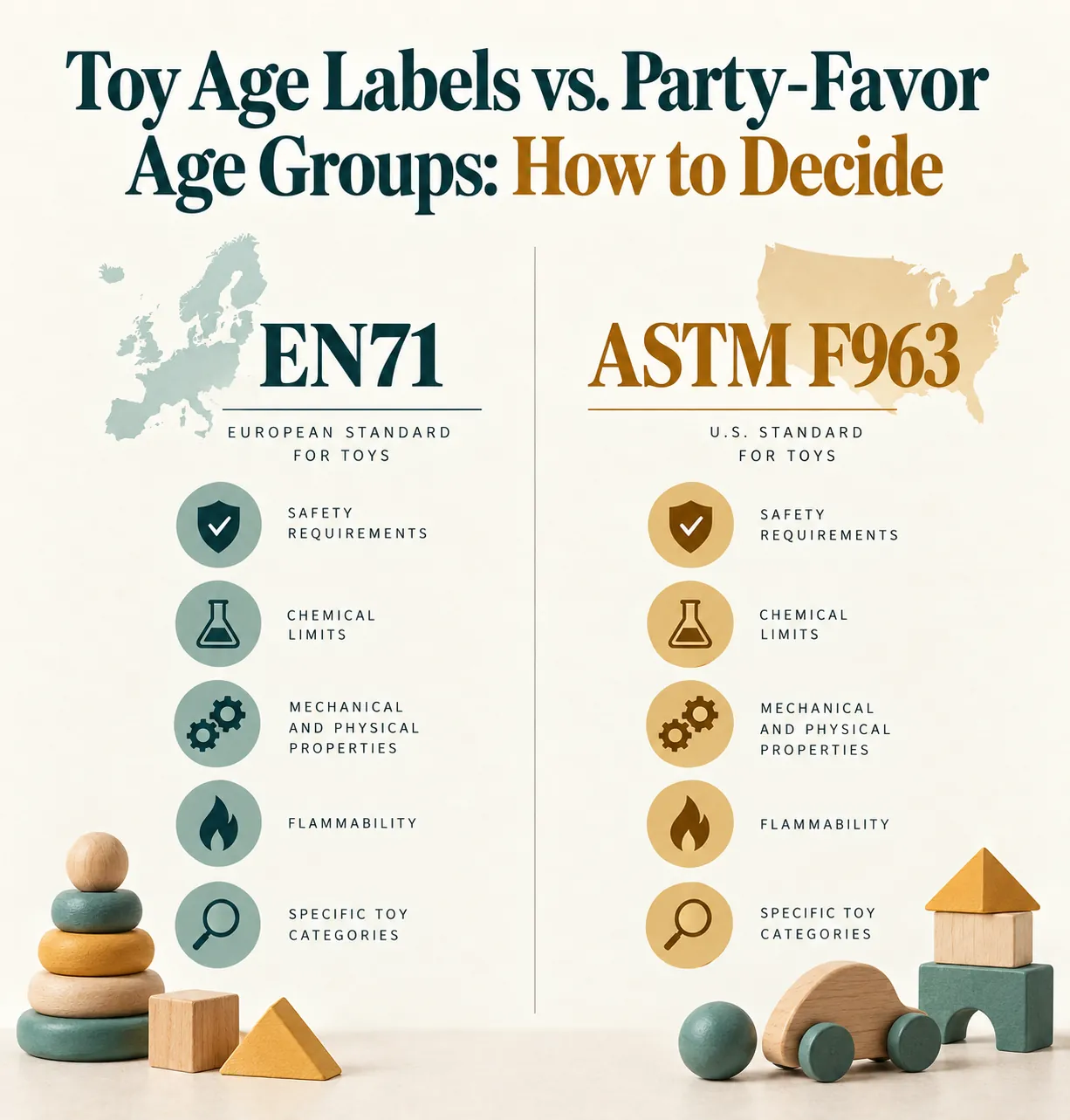
Choose party favors by the product’s supported age determination, not by the birthday age or guest list alone. Toy age labels should reflect the product and its intended and reasonably foreseeable use; the party’s age group is a purchasing filter, not a substitute for that assessment. For US orders, review the age rationale, applicable hazards, packaging, and test-report coverage together. Keep small-parts warnings separate from age grading, and do not treat a report’s age field as independent approval.
What determines the appropriate toy age label?
Age determination requires evaluating the product and likely use together; neither a manufacturer’s label nor a packaging photograph decides the answer alone. CPSC considers the manufacturer’s intended-use statement alongside reasonably foreseeable use, and recognizes packaging, instructions, photographs, and advertising as evidence of intended users. Its January 2020 Age Determination Guidelines are also a classification factor. CPSC: Children’s Products
As a purchasing review, record how children are expected to play with the item, the skills the activity calls for, and whether the proposed age matches that interaction. Compare this rationale with the actual construction and marketing—not just the number printed beside “ages.”
For a mixed-age party, select favors only after checking each product’s supported age range against its intended recipients. Separate the assortment where necessary rather than letting the birthday child’s age stand in for every guest’s suitability.
Which age and hazard decisions must stay separate?
| Children’s-product classification | A US consumer product designed or intended primarily for children 12 years of age or younger falls within this definition. This boundary does not establish a particular toy’s age grade. |
|---|---|
| Small-parts ban | Covered products intended for children under 3 that present choking, aspiration, or ingestion hazards because of small parts are banned hazardous substances. Applicable exclusions must also be considered. |
| Small-parts identification | The criterion includes objects fitting entirely into the specified cylinder, without compression and in any orientation, as well as applicable pieces detached during simulated use or abuse testing. |
| Choking-hazard warnings | Certain products require warnings under 16 CFR 1500.19. Advertising for children’s toys subject to these warning requirements must carry the same warning under 16 CFR 1500.20. |
How should the label and test report agree?
A test report’s age field does not, by itself, justify the retail age label. As a buyer’s consistency check, compare the proposed label with the age rationale, product identity, assessed construction, packaging, and report scope.
If the report and packaging show different ages, pause artwork approval and request an explanation of the difference. Establish whether the report covers the version being purchased and whether its assessment supports the proposed labeling; copying whichever age is higher is not a sound resolution.
Review any applicable choking warning separately. Do not use a warning, a higher-age sticker, or an adult-supervision statement as a substitute for establishing the product’s intended age and applicable safety requirements. A visual or hand inspection can flag questions, but cannot establish legal safety.
How does this apply to a marble-run party favor?
A marble-run product name identifies an activity, not a verified age grade. For the Space Marble-Run Construction Set, ask what age rationale supports the proposed label and whether the assessment covers all supplied components, including any marbles.
Then ask how applicable small-parts testing addresses components released during simulated use or abuse. Keep those questions separate from whether the set suits the party theme; neither its appearance nor a simple assembly demonstration resolves them.
What should buyers request before approving the order?
Request the proposed age label and its rationale, the exact product version, relevant reports, and final packaging and listing artwork before approving the order. Resolve any disagreement among those records before committing to a party assortment.
Use the certifications page to frame the documentation discussion, then include the destination market, intended recipients, and exact product in a quote request. For EU or other destinations, request a separate market-specific assessment rather than treating the US framework as transferable approval.