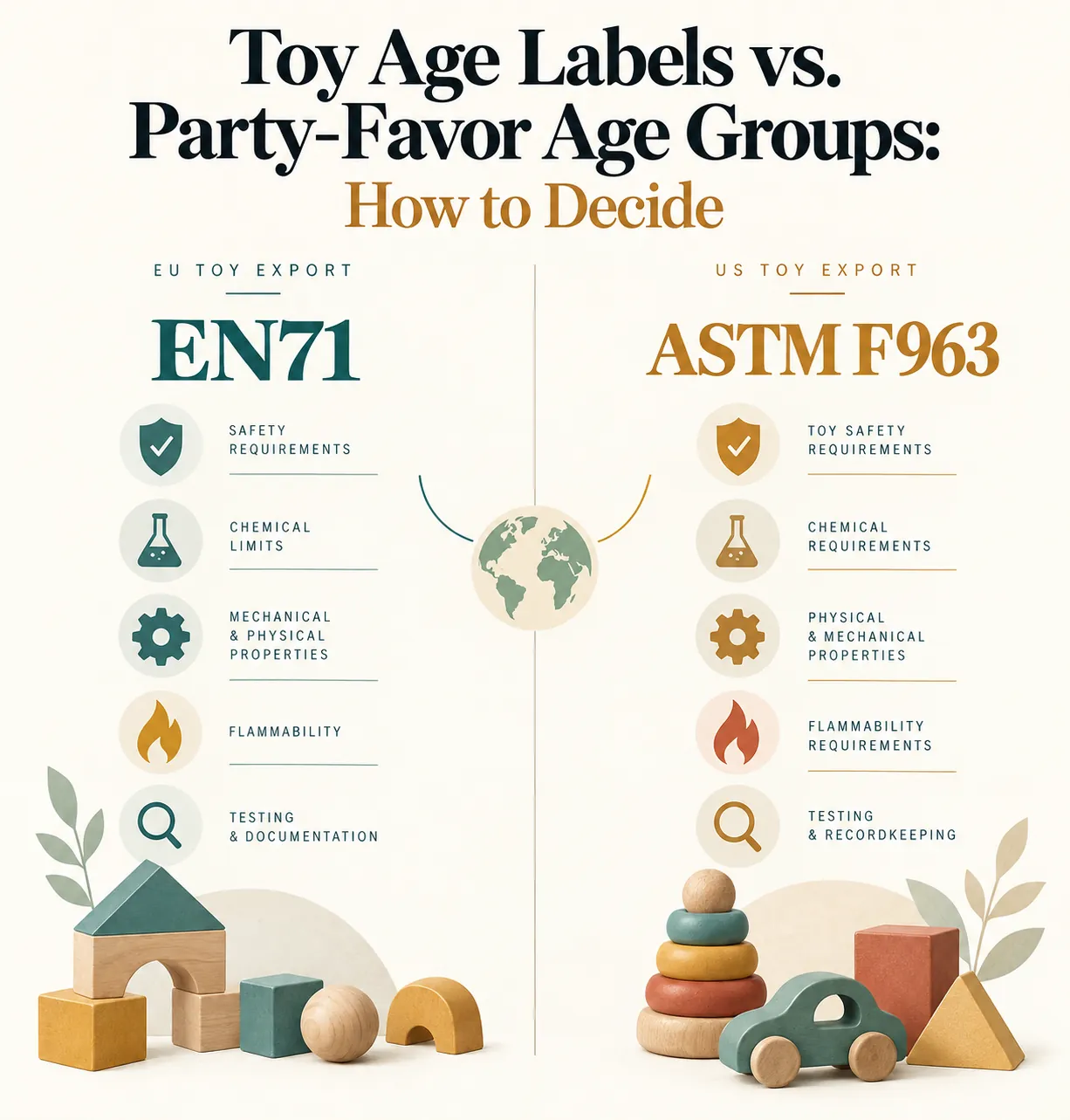
The party-favor age group is a marketing input; the toy age label is a safety determination. When a 3+ favor bag is being sold into a 2-year-old's birthday party, the label does not bend to the guest list. Under US law, a children's product is a consumer product designed or intended primarily for children 12 years of age or younger, and the CPSC weighs the manufacturer's stated intended use alongside reasonably foreseeable use — not the retailer's party theme. CPSC Children's Products
The practical decision for a shop or party supplier is this: keep the statutory children's-product scope, the age grade, the small-parts rule, and the choking-hazard warning as four separate questions. Do not let a party age group, a packaging photo, or a test report's age field decide the label on its own. If the four answers disagree, the conservative label wins and the SKU stays out of the younger party bin.
What does the CPSC actually use to decide if a toy is for children?
The statutory definition is age 12 or younger, and the CPSC says it will consider the manufacturer's statement of intended use and also the product's reasonably foreseeable use. A manufacturer is expected to know its product and what a child using it might reasonably be expected to do with it. That is a two-sided test: your stated age on the box is evidence, but it is not the only evidence.
Representations count. The CPSC lists expressed representations (advertising that says the product is for children 12 or younger) and implied representations (advertising showing the product being used by young children) as the types of product representations it considers. A party-favor listing that shows toddlers holding the item is an implied representation, even if the carton says 6+.
The January 2020 Age Determination Guidelines issued by Commission staff were mandated by Congress as one of four statutory factors for determining whether a consumer product is primarily intended for a child 12 or younger. CPSC Children's Products The guidelines match product characteristics to the skills, interests, and play behaviors of children in each age group, and the 2020 update added a category called "Technology Play" to reflect electronic toys and smart devices. ACT LAB
What this means for a buyer: the age grade is a conclusion drawn from the product, its play pattern, and how it is marketed. It is not a number you can copy from a party aisle sign or a competitor's listing.
Why a party-favor age group is not an age grade
Party-favor age groups are set by the host, the theme, or the guest list. Age grades are set by the product's design, foreseeable use, and the applicable safety rules. A 4-year-old's party can hand out a 3+ item; a 2-year-old's party cannot make a 3+ item safe for a 2-year-old.
The distinction matters commercially because the two numbers are produced by different processes. The party group is a planning label. The age grade is a compliance and liability position that should be documented before the SKU is listed, not after a return or an incident.
A practical rule for party suppliers: if the party age group is younger than the product's age grade, the product does not belong in that favor bag. If the party age group is older, the product can be offered, but the label and warning still travel with it.
How do small-parts rules interact with the age label?
Small parts are a separate question from the age grade. Under the CPSC small-parts framework, children's products intended for use by children under 3 that present a choking, aspiration, or ingestion hazard because of small parts are banned hazardous substances, codified at 16 C.F.R. part 1501. CPSC Small Parts
Small-part identification is mechanical: a small part is any object that fits, without compressing and in any orientation, entirely into the small parts cylinder at 16 C.F.R. § 1501.4, which approximates the size of the fully expanded throat of a child under three. CPSC Small Parts You cannot decide this from a photo, a mechanism, or a hand squeeze.
Certain children's products that are or contain small parts, balloons, small balls, or marbles must be labeled to warn consumers not to buy them for children under a certain age, codified at 16 C.F.R. § 1500.19, and any advertising for covered children's toys must use the same warning per 16 C.F.R. § 1500.20. CPSC Small Parts
Two consequences for buyers. First, a choking-hazard warning is not a substitute for the small-parts ban — a warning does not make an under-3 product compliant. Second, a warning is not the same as an age grade; the warning tells the buyer not to purchase for a certain age, while the age grade describes the intended user.
What a test report does and does not tell you about age
A report's age field is an input, not the decision. The report documents what was tested against which clauses; it does not by itself establish the correct age label for your listing, your packaging, or your party use.
For the small-parts ban, the citation to use in section 2 of the Children's Product Certificate is "16 CFR part 1501 – Small parts." The choking-hazard warning label requirement does not need to be included in a CPC. CPSC Small Parts That separation is useful: it tells you the certificate and the warning are different documents doing different jobs.
When reviewing supplier paperwork, ask for reports that name the exact product and factory address and cover every color and material. That is a commercial vetting recommendation, not a legal validity period; a report dated within a year is a supplier-vetting convention, not a regulatory expiration rule. Importivity
Age-label decision worksheet for a party or gift SKU
| 1. Statutory scope | Is the product designed or intended primarily for children 12 or younger? Consider stated intended use and reasonably foreseeable use. |
|---|---|
| 2. Representations | Do packaging, listing images, or advertising show or imply young children using the product? Implied representations count. |
| 3. Age grade | What age grade does the product's characteristics, play pattern, and the Age Determination Guidelines support? |
| 4. Small-parts status | Does any component fit entirely into the 16 C.F.R. § 1501.4 cylinder without compression, in any orientation? |
| 5. Under-3 applicability | If the product is intended for children under 3 and presents a small-parts hazard, is it excluded from the market? |
| 6. Warning label | Does the product fall within the categories requiring a choking-hazard warning under 16 C.F.R. § 1500.19, and does advertising carry the same warning under § 1500.20? |
| 7. Party group | Is the party-favor age group younger than the age grade? If yes, do not place the product in that favor bag. |
| 8. Documentation | Do you have a written rationale for the age grade, the applicable standard clauses, and the label placement? |
What to do when the label, the report, and the party group disagree
The conservative answer wins. If the age grade is 3+ and the party group is 2-year-olds, the product does not go in the bag. If the report says the item was tested but the packaging shows a toddler, the packaging is a representation that can pull the product into the children's-product scope — fix the image or fix the product.
Document the reasoning. A short age-grading rationale memo, a standards matrix listing the specific ASTM or EN71 clauses that apply, and a labeling checklist for warning font size and placement are reasonable commercial documents to keep on file. LeelineToys Treat them as your own due-diligence record, not as a regulator-issued certificate.
Do not rename the product to escape the rule. Calling a toy a décor piece or a display item does not change its intended use if it is marketed to children. The CPSC looks at the product and its representations, not the label you prefer.
Key US age and small-parts references at a glance
| Children's product definition | Consumer product designed or intended primarily for children 12 years of age or younger. |
|---|---|
| Classification factors | Manufacturer's statement of intended use and reasonably foreseeable use; representations expressed or implied. |
| Age Determination Guidelines | Issued by Commission staff January 2020; one of four statutory factors; includes a "Technology Play" category. |
| Small-parts ban | 16 C.F.R. part 1501; applies to children's products intended for children under 3 that present a choking, aspiration, or ingestion hazard because of small parts. |
| Small-parts cylinder | 16 C.F.R. § 1501.4; object fits entirely, without compression, in any orientation. |
| Choking-hazard warning | 16 C.F.R. § 1500.19 for certain children's products; advertising warning under 16 C.F.R. § 1500.20. |
| CPC citation for small parts | "16 CFR part 1501 – Small parts" in section 2 of the CPC; the choking-hazard warning does not need to be in the CPC. |
Buyer questions on age labels and party groups
Can adult supervision make a 3+ toy safe for a 2-year-old?
No. Supervision does not change the age grade or the small-parts status. If the product is intended for children under 3 and presents a small-parts hazard, it is a banned hazardous substance under 16 C.F.R. part 1501.
Does a test report's age field set my age label?
No. The report documents what was tested. The age label should follow the product's intended use, reasonably foreseeable use, and the Age Determination Guidelines.
Is a choking-hazard warning the same as an age grade?
No. The warning tells consumers not to buy for children under a certain age; the age grade describes the intended user. They are separate requirements.
If the party theme is for 2-year-olds, can I still sell a 3+ item as a favor?
Only if the item is not placed in the 2-year-old favor bag. The party age group does not lower the age grade.
Do I need a CPC for every SKU?
The CPC citation for the small-parts ban is "16 CFR part 1501 – Small parts." Whether a CPC is required for a given product depends on the applicable rule; confirm with your compliance advisor or testing lab.
What documents should I keep on file?
A written age-grading rationale, a standards matrix naming the applicable clauses, and a labeling checklist. These are commercial due-diligence records, not regulator-issued certificates.
Sources
- Children's Products | CPSC.gov
- Small Parts Ban and Choking Hazard Labeling
- CPSC Update: New Age Determination Guidelines for Toys and Children's Products - ACT LAB
- Proven Toy Age Grading Guidelines – A Seller's Quick Guide
- Toy Manufacturers in China and How to Vet One | Importivity MANAGEMENT TECHNICAL SUPPORT GEAR CONTAINER DOCUMENTS
Next step for your age-label review
If you are preparing a party or gift SKU for the US market, start with the worksheet above and confirm the small-parts status before you print packaging. For certification documentation and testing coordination, see our certifications page. To discuss a specific item and request current age, packaging, and compliance details, submit a quote request.