Start with the question at your counter
The most useful trend clue may be a customer asking for a particular shape. Keep a notebook of requests, the words shoppers use and what they pick up but leave behind. Online sellers can record questions on their own listings and searches within their shop. Treat social posts as ideas to investigate, not proof that a style will sell in your location. This guide is a buying method, not a national bestseller ranking.
Build a three-part opening edit
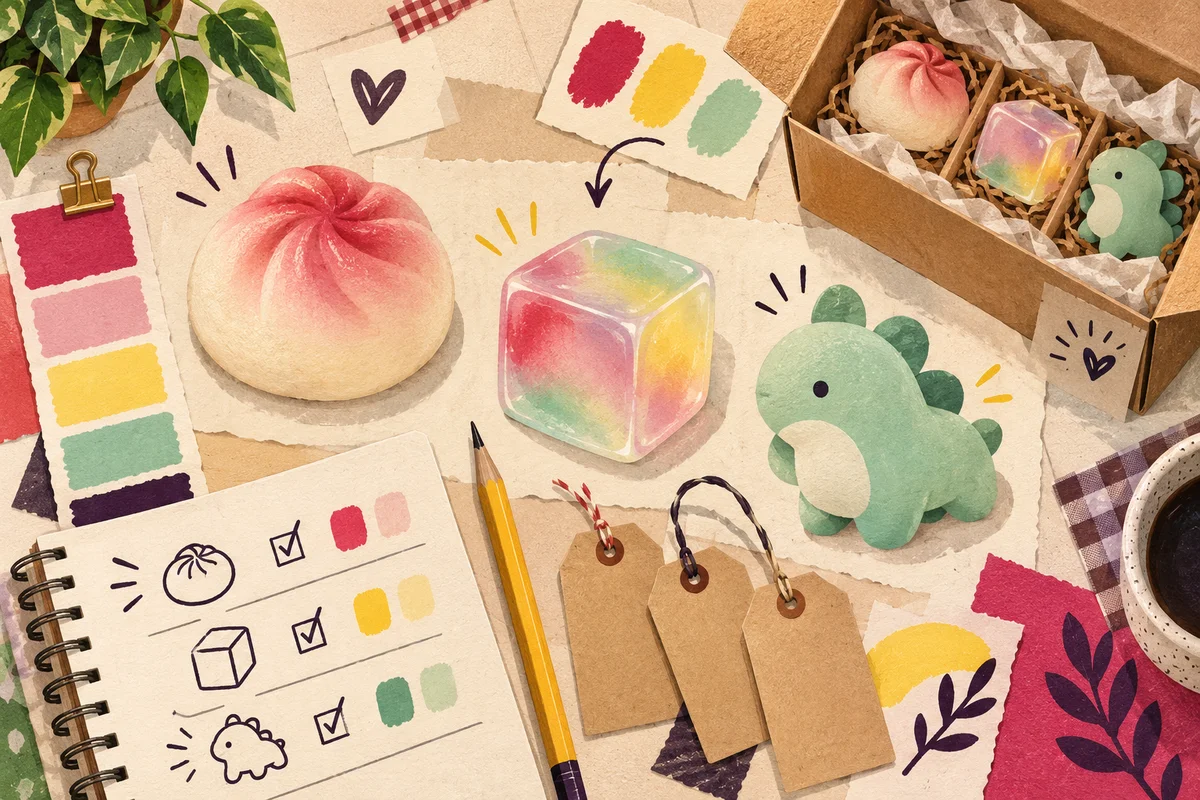
Choose one familiar shape, one visual contrast and one item that changes the gift format. In the current catalog, a white slow-rise bun can anchor a bakery theme; a mini maltose ice cube changes the silhouette; a dumpling calendar changes the presentation. These are different products with different minimums, not a prepacked three-item bundle. Start with the price, carton count and packaging of each SKU before combining them into a buying budget.
Give every candidate a job
Write one sentence about why an item belongs: entry-price counter pick, texture comparison, party theme or boxed gift. Then identify where it will sit and what it will replace. A second near-identical bun should earn its space through a visible color, size, filling or pack difference. If staff cannot explain the difference quickly, simplify the selection before ordering. For online shops, use the same exercise to decide whether the item needs a separate listing or a clearly labeled variation.
Run a fair shelf test
Choose a review period before the stock arrives. An illustrative four-week test is long enough to establish a routine, but your store may need another period. Record opening saleable units, units sold, sample units, damaged units and days unavailable. Keep location and price stable where possible. A style that was out of stock for half the test cannot be compared fairly with one that was always available. Record results by SKU, not just by the broad word squishy.
Read turnover alongside the money
For example, selling 18 of 36 saleable units gives 50% sell-through over the chosen period. That percentage says nothing by itself about profit or a competitor. Compare the gross profit those 18 sales contributed with the shelf space and buying cash the line required. Use landed cost rather than the EXW catalog price. A lower-priced item with a high carton quantity may commit more cash than a more expensive item with a smaller opening quantity.
Reorder the evidence, refresh the experiment
Keep a proven line in its exact SKU and packaging, then change one weaker position at a time. Estimate a reorder using average weekly unit sales multiplied by the confirmed replenishment lead time, add a chosen buffer, and subtract usable stock plus stock already on order. Replace estimates with the current quote. Your own records make the next carton less of a guess, while leaving room for a new shape that customers ask about.
Your four-week trial sheet
| Record | What to write down |
|---|---|
| Product | SKU, pack format, landed unit cost |
| Opening stock | Saleable pieces, excluding samples |
| Weekly result | Units sold, stockout days, returns |
| Decision | Reorder, adjust the display, or replace the line |
Planning aid; use the confirmed product details and your own costs.
Where these squishies actually come from
Trends travel through a supply chain, and most arrive at your shelf too late because of the chain, not the product. The styles on this site come from our personally audited partner factories in Chenghai District, Shantou, Guangdong, China — the world’s largest toy manufacturing cluster — and are handled by a trading team with more than 20 years of export experience. That pairing explains the practical advantages behind these guides: fast sampling, low-MOQ mixed cartons, shelf-ready and private-label (OEM/ODM) packaging, capsule formats for gachapon programs, promotional and full-container capacity, and per-SKU compliance documentation — such as ASTM F963/CPSIA-related reports for the US and EN 71/CE-related documents for Europe — confirmed against the exact production batch. Buy wholesale squishies the way the method in this guide suggests: test small, measure honestly, scale what proves out.
Questions behind this guide
Sourcing FAQ
How does the Chenghai cluster help me catch trends faster?
Chenghai, Shantou is the world's largest toy manufacturing cluster: mould, material, printing, filling, assembly and packing sit within minutes of each other, so a trending shape can be sampled and produced while the trend is still rising rather than after it peaks.
Can I test a trend with a small order?
Yes. Many styles start from one carton with mixed designs, so you can measure real sell-through before committing to repeat cartons or container quantities.
How do I know a trending style is not a short-lived fad?
Run the measured shelf test described above; your own unit sales over a fixed period are more reliable than social buzz. Reorder SKUs that prove out and drop the rest.
Can a proven trend be made under our own brand?
Yes. Proven styles can move into OEM/ODM private label with custom colors, scents, logos, tags and display packaging.