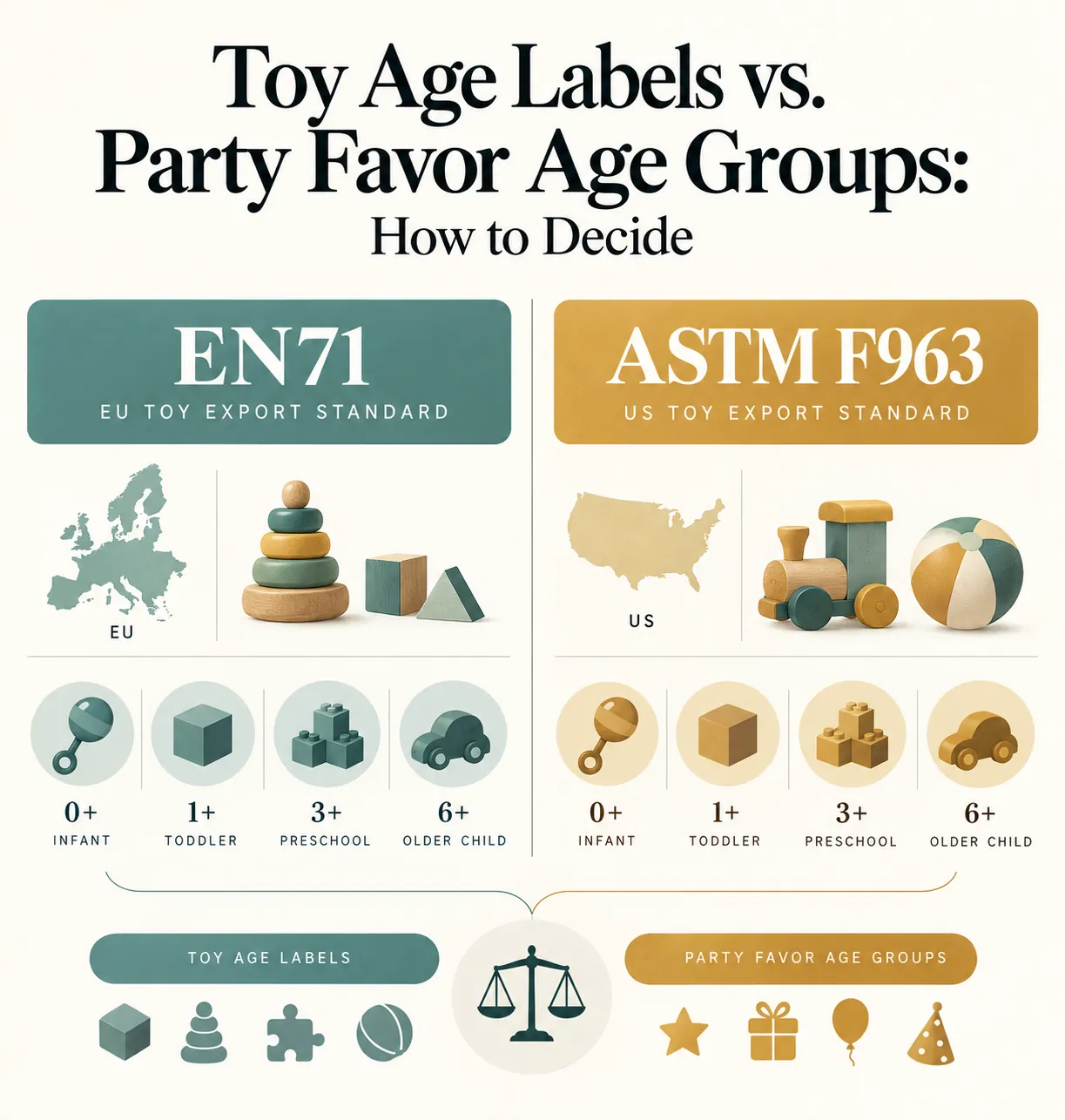
A party favor age group is a merchandising choice; a toy age label is a safety determination. If you are buying squishy party favors in bulk, decide the age label first, then build the party-favor grouping around it — never the reverse. Under CPSC rules, a product label is only one factor in classifying a children's product, and the commission weighs it against expected use patterns CPSC Children's Products. Practically: for any item you intend to sell to children 12 and under, confirm the manufacturer's age determination, the small-parts status, and third-party test scope before you list it.
What actually determines a toy's age label?
Age grading is the manufacturer's task of matching a product to the developmental stage of its intended audience, and CPSC expects it to be done with its Age Determination Guidelines CPSC Children's Products. The label is the output of that analysis, not the input.
Three inputs drive it: who the product is designed and primarily intended for, how it will realistically be played with, and what hazards the construction presents at that developmental stage. A box printed "Ages 3+" does not override the analysis. If a product visually appeals to a two-year-old, the physical abuse testing should match a toddler's use, not the printed number Lee Lin Toys age grading guide.
This is why age determination is not a marketing field. It changes the depth and type of safety testing a product must undergo ACT LAB on the 2020 guidelines.
Does a party-favor age group create a legal age grade?
No. "Party favor for ages 4–8" is a shelf or listing convention. It has no regulatory weight. What matters is whether the product is a children's product, and if so, for which age band.
The distinction gets sharper with caregiver products. CPSC has clarified that items intended to be used with children by a parent or caregiver — diaper bags being the standard example — are general use products, not children's products CPSC Children's Products. A favor bag, a treat tote or a party prop used by an adult is not automatically a children's toy. But the moment the item is designed and primarily intended for the child to play with, the children's product rules attach.
Kits are the trap. If a kit is designed and primarily intended for children 12 or younger, every element in the kit is treated as a children's product and must comply CPSC Children's Products. That includes the filler items you might otherwise think of as accessories.
How small-parts warnings differ from age grading
These are two separate systems, and conflating them is where recalls start.
Age grading decides who the product is for. The small-parts rule decides whether a product intended for children under three may exist at all. Children's products intended for use by children under three that present a choking, aspiration or ingestion hazard because of small parts are banned hazardous substances CPSC small parts guidance.
That ban is not a labeling problem. A "not for children under 3" warning does not convert a banned product into a sellable one. The exclusion list at 16 C.F.R. § 1501.3 covers specific categories — books and other paper articles, writing materials such as crayons, chalk, pencils and pens, and children's clothing and accessories — and it is a defined list, not a general escape hatch CPSC small parts guidance.
The 2026 recalls show the pattern. Esjay's toddler busy board was recalled because the product was for children under three and red knobs could detach, violating the small parts ban CPSC Esjay recall. TheKiddoSpace peg dolls were recalled on the same basis — intended for under-threes, and the peg dolls could block a child's airway CPSC TheKiddoSpace recall. Joyreal's busy board failed on the small mirror detaching and separately on sharp edges under the mandatory toy standard CPSC Joyreal recall. ATOYUS activity cubes failed on detaching xylophone screws and clock hands, and again on spherical mallet ends CPSC ATOYUS recall.
Magnet products sit in a related but distinct lane. Kluster magnet chess games were recalled because loose high-powered magnets fit within CPSC's small parts cylinder, creating an ingestion hazard under the mandatory toy standard CPSC Stoney Games recall. Do not fold magnet ingestion into the under-three small-parts ban when you brief a supplier; they are different rule sets with different fixes.
When does third-party testing apply, and what does a report's age field prove?
CPSC testing and certification requirements apply to products designed or intended primarily for children 12 years of age or younger CPSC Toy Safety. If your favor item is a children's toy, that testing is part of the deal, not an upsell.
Two clarifications buyers routinely get wrong. First, mandatory labeling requirements do not themselves require compliance assessment by a CPSC-accepted third-party laboratory — labeling and testing are separate obligations CPSC Toy Safety. Second, the age field on a test report is a record of what was tested. It does not by itself determine the correct age label. If the report says "3+" but the product's appeal and construction point younger, the report does not settle the question.
Federal law also prohibits any person from selling products subject to a Commission-ordered recall or a voluntary recall undertaken in consultation with CPSC. That applies to you as the reseller, not just the importer CPSC CBC Group recall.
Decision worksheet: label, warning or test scope?
| Product is designed and primarily intended for children 12 or under | Children's product — third-party testing and certification apply |
|---|---|
| Product is used by a parent or caregiver with the child (e.g. diaper bag) | General use product — children's product rules do not attach on that basis alone |
| Kit designed and primarily intended for children 12 or under | Every element in the kit is treated as a children's product |
| Intended for children under 3 and a component fits the small parts cylinder | Banned hazardous substance — a warning label is not a workaround |
| Product falls in the 16 C.F.R. § 1501.3 exclusion list | Excluded from the small parts ban — verify the item genuinely fits the listed category |
| Contains loose high-powered magnets that fit the small parts cylinder | Assess against the mandatory toy standard for magnet ingestion — separate from the under-three ban |
| Report age field says one band, product appeal suggests a younger band | The report does not decide the label — re-examine intended use and construction |
| Item appears on a CPSC recall notice | Federal law prohibits sale — remove from listings and stock |
What to ask before you commit to a party-favor order
Ask for the manufacturer's age determination rationale, not just the printed age. A supplier who can explain why the product suits a developmental stage is a different supplier from one who reads a number off a carton.
Ask which age band was tested and what abuse testing that band triggered. Drop, torque and tension severity track the age grade, and chemical limits move with it too Lee Lin Toys age grading guide.
Ask for the small-parts status in plain terms: does any component fit the cylinder, and is the product intended for under-threes? If the answer to both is yes, stop. There is no warning-label route through it.
Ask whether the item or its components appear on any CPSC recall notice. Check the model number, not just the product name — ATOYUS activity cubes were recalled under a specific model number CPSC ATOYUS recall.
Finally, check your own listing copy. Marketplace algorithms cross-reference listed age grades against visual features, and mismatched listings risk suppression Lee Lin Toys age grading guide. If your photo shows a toddler mouthing the item and your listing says 6+, that gap is a problem you created.
Where catalog data stops and verification begins
A catalog entry tells you material, size and packaging. It does not tell you the age grade, the small-parts result or the test scope. A material field describing a casing or component does not describe the whole toy's construction, and a photo cannot substitute for a physical small-parts assessment.
For squishy and foam favor items, the verification questions are concrete: does the item or any detachable part fit the small parts cylinder, what age band was it tested to, and does the test report cover the construction you are actually buying. Slow-rebound foam and TPE squishies are soft, but softness is not a small-parts exemption — a detached piece is a detached piece.
If you need to confirm test documentation or scope for a specific item, the certification path is the place to start: certifications. If you want current pricing, carton configuration or a mixed-carton request for a specific favor item, raise it through quote — treat any catalog price as indicative EXW per stated selling unit and confirm it before you build a margin.
Buyer questions on age labels and party favors
Can I sell a product labeled 'not for children under 3' if it has small parts?
Not if the product is intended for children under three. Children's products intended for under-threes that present a choking, aspiration or ingestion hazard because of small parts are banned hazardous substances, and the warning label does not change that.
Does a party favor automatically count as a children's product?
No. The test is design and primary intended use. Items intended to be used with children by a caregiver are general use products; items designed and primarily intended for the child to play with are children's products.
If a kit contains small accessories, are those accessories covered?
If the kit is designed and primarily intended for children 12 or younger, all elements included in the kit are considered children's products and must comply.
Does the age on a test report settle the age label?
No. The report records what was tested. Age determination weighs intended use, expected play patterns and construction, and the label on the product is only one factor CPSC considers.
Do labeling requirements need a third-party lab?
No. CPSC states that labeling requirements do not require compliance assessment by a CPSC-accepted third-party laboratory. Testing and labeling are separate obligations.
What age band triggers third-party testing?
Products designed or intended primarily for children 12 years of age or younger fall within CPSC's testing and certification requirements.
Do magnet toys follow the same rule as small parts?
No. Loose high-powered magnets that fit the small parts cylinder are assessed under the mandatory toy standard for ingestion hazard, which is a separate rule set from the under-three small-parts ban.
Can adult supervision make an under-three item acceptable?
No. Supervision is not a compliance mechanism. The small parts ban applies to the product's intended use, not to how closely an adult watches.
Sources
- Children's Products | CPSC.gov
- Small Parts Ban and Choking Hazard Labeling | CPSC.gov
- Toy Safety Business Guidance | CPSC.gov
- CBC Group Recalls Stephan Baby Boo Bunnie and Friends Children’s Toys Due to Risk of Serious Injury from Choking and Lac
- Esjay US Recalls Toddler Busy Board Montessori Toys Due to Risk of Serious Injury or Death from Choking; Violates Small
- TheKiddoSpace Recalls Peg Doll Children’s Toys Due to Risk of Serious Injury or Death from Choking Hazard; Violate Small
- Joyreal Busy Board Children’s Toys Recalled Due to Risk of Serious Injury or Death from Choking and Laceration Hazards;
- Stoney Games Recalls Kluster Magnet Chess Games Due to Risk of Serious Injury or Death from Magnet Ingestion; Violates M
- ATOYUS Children’s Activity Cubes Recalled Due to Risk of Serious Injury or Death from Choking Hazard; Violate Small Part
- CPSC Update: New Age Determination Guidelines for Toys and Children's Products - ACT LAB
- Proven Toy Age Grading Guidelines – A Seller's Quick Guide