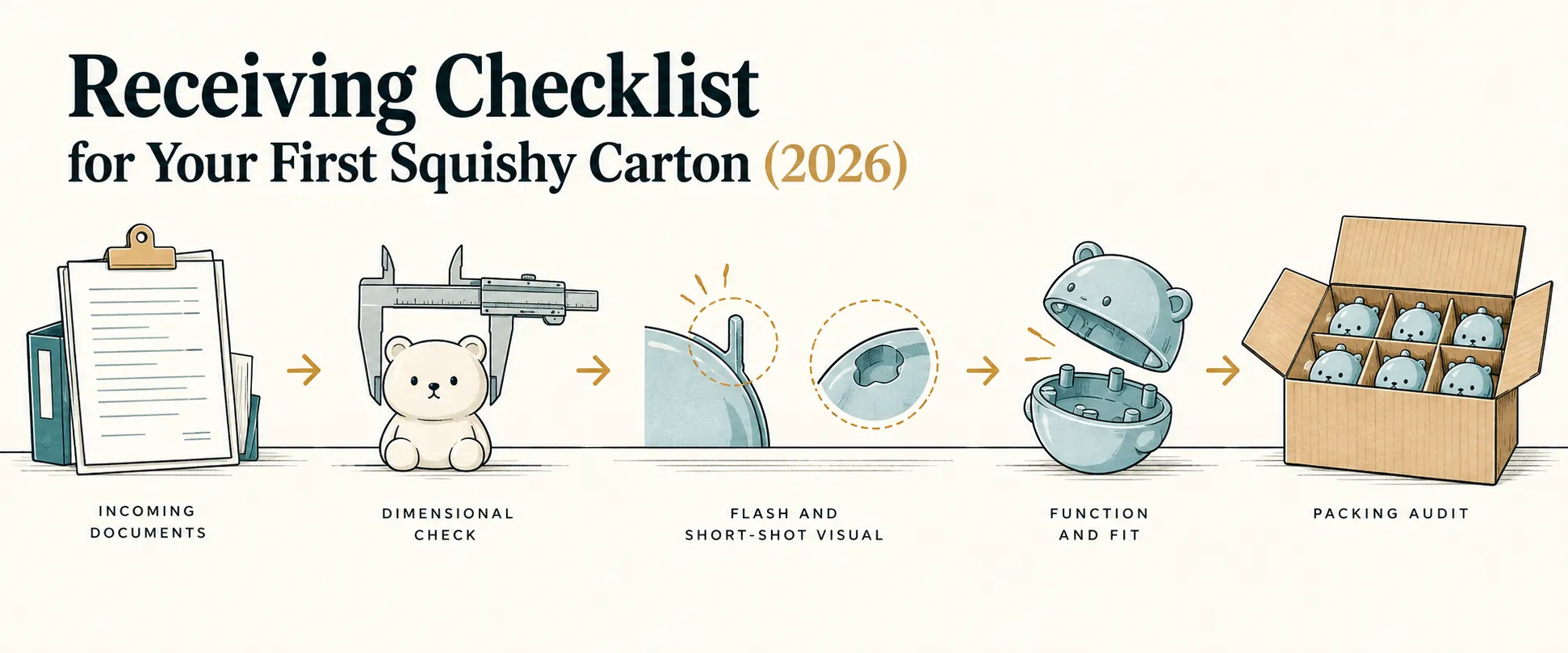
Open the carton against a written record, not against memory: measure the carton in centimetres, count the selling units, weigh one carton, photograph the shipping marks and the inner pack, then log every difference before the stock goes on the shelf. For a first squishy carton, the record you compare against is the packing list plus the pre-order packing data you agreed with the supplier — not the product photo on the listing page. A carton check confirms what arrived; it is not product-safety certification and it does not replace pre-shipment inspection.
The practical outcome of this checklist is a signed-off receipt, a short discrepancy note with photos, and a decision: release the carton, hold it, or raise a claim with the supplier. Work through the sequence below in order, because a count error found before you break the inner packs is far cheaper to resolve than one found after the stock is mixed into inventory.
What to check, what to compare it against, and what to do when it doesn't match
| Carton dimensions (L × W × H in cm) | Compare against the pre-order packing data and the packing list. Measure the closed carton at its longest, widest and highest points. Small differences within a tolerance you agreed with the supplier are normal; a large difference usually means the pack configuration changed. Next decision: if the difference is outside your agreed tolerance, photograph the carton with a tape measure in frame and ask the supplier to confirm the actual pack. |
|---|---|
| CBM per carton and total CBM | Calculate L(cm) × W(cm) × H(cm) ÷ 1,000,000 for one carton, then multiply by the number of cartons. Compare the total against the figure on the packing list or freight documents. Next decision: a total CBM that differs from the booked figure affects freight cost and container fill — raise it with the supplier and your forwarder before the shipment is cleared. |
| Unit count per carton | Compare against the carton quantity stated for that exact SKU and pack configuration. Count the selling units, not the inner boxes. Next decision: short or over count outside your agreed tolerance goes into the discrepancy note with the carton number; do not adjust inventory until the supplier confirms. |
| Carton gross weight | Compare against the weight on the packing list. Weigh one carton on a floor scale if you have one. Next decision: a weight that is clearly out of line with the count often points to a packing or material change — flag it and ask before releasing. |
| Shipping marks and labels | Compare against the marks you approved: SKU, description, quantity, carton number, destination and any handling symbols. Next decision: wrong or missing marks on a carton that must be split or stored separately is a labelling correction request, not a reason to refuse the whole shipment. |
| Outer carton condition | Compare against what you would expect for a carton that has travelled by sea or air: no crushing, no water staining, no re-taping that suggests the carton was opened in transit. Next decision: photograph the damage before opening, note it on the carrier's delivery document, and quarantine any carton with crushed or wet contents. |
| Inner pack and product condition | Compare against the approved sample and the agreed pack photo. Check the inner pack, the display box or colour box, and the product itself for visible damage or contamination. Next decision: separate non-conforming units from saleable stock and hold them in a labelled quarantine area until the supplier responds. |
| Documentation traceability | Compare the documents you hold against the exact item being sold: a dated product specification, any available test or conformity evidence, marking reference, user instruction and packing proposal for the offered configuration. Next decision: if the document does not name the item you received, ask the supplier for the version that does before you rely on it. |
Which record do you compare the carton against?
The record is the packing list, cross-referenced against the purchase order and the pre-order packing data you agreed before the PO went out. That pre-order data is the supplier's stated carton dimensions, carton quantity and gross weight for the exact SKU and pack configuration. The final packed measurement is what you take off the closed carton on your floor. These are two different numbers, and the gap between them is where most first-carton surprises live.
Do not compare against the product listing page. A listing shows the selling unit and the indicative price; it does not tell you what the packed carton weighs or how the inner packs are arranged. If the supplier sent a packing proposal, that proposal is the document to open first. If the shipment arrived with a packing list that names a different carton quantity than the one you ordered, treat that as the first discrepancy to log — before you count anything.
Documentation only has value when it is traceable to the item being sold. A generic certificate or a specification sheet for a different configuration does not verify the carton in front of you. Ask for the dated specification and any available test or conformity evidence that names the exact configuration you received, and keep it with the receiving record.
How to calculate squishy carton cost and CBM from the packed carton
The CBM calculation is the same for any carton: length in centimetres × width in centimetres × height in centimetres ÷ 1,000,000 gives cubic metres for one carton. Multiply that by the number of cartons in the shipment to get total CBM. Here is a worked hypothetical, not a catalog figure: a carton measuring 60 cm × 40 cm × 35 cm gives 60 × 40 × 35 = 84,000 cm³, and 84,000 ÷ 1,000,000 = 0.084 CBM per carton. Twenty such cartons give 0.084 × 20 = 1.68 CBM. Substitute your own measured dimensions — the arithmetic is the point, not the numbers.
Carton cost calculation works the same way at the unit level. Take the indicative EXW price per selling unit, multiply by the units per carton, and you have the goods value of one carton before freight. Add the freight and duty allocated per carton to reach a landed cost per carton, then divide by the units per carton for a landed cost per unit. Keep the two figures separate in your records: the EXW price is the supplier's quote and needs current confirmation, while the landed figure is your own calculation and changes with every freight quote.
Catalog figures belong to their exact SKU and pack configuration. A carton quantity of 144 pieces on one product does not transfer to another product, and a price quoted per piece is not a price per carton. When you build the receiving record, write the SKU, the pack configuration and the carton quantity on the same line so the numbers cannot drift apart later.
What counts as a discrepancy, and what happens next
A discrepancy is any difference between the carton in front of you and the record you agreed — count, dimensions, weight, marks, condition or documentation. Not every difference is a failed shipment. Set a tolerance with the supplier before the order ships, in writing, covering count and dimension variation, and apply that tolerance consistently. A carton that is two centimetres longer than the packing data is a note; a carton that holds 120 pieces when the packing list says 144 is a claim.
When you find a discrepancy, record the product code, the quantity affected and the specific condition, and photograph the carton with the carton number visible. That documentation is what you send to the supplier and what you use to update your own inventory records. Quarantine non-conforming units in a labelled holding area so they cannot be picked, sold or shipped by mistake while the claim is open.
The next decision depends on the check. A count or dimension difference outside tolerance goes back to the supplier for confirmation or correction. Visible transit damage goes to the carrier and your freight insurer with photos taken before the carton was fully opened. A documentation gap — a specification that does not name the received configuration — goes to the supplier as a document request, and you hold the stock until it is resolved. A carton that passes every check is released to saleable inventory and the receiving record is signed and filed.
Where the carton check stops and product-safety release begins
A carton check confirms that the right goods, in the right quantity, arrived in saleable condition. It does not certify the product. Product-safety release is a separate check against the applicable rules for the market where you sell, using the specified laboratory test for a safety conclusion — a hand check, a squeeze, or a pull on a component does not determine age suitability and does not certify anything.
Treat the two as separate gates. Gate one is the carton: dimensions, count, weight, marks, condition, documentation traceability. Gate two is the product: the applicable safety requirements for your market, matched to the exact toy configuration, with laboratory acceptance matched to the relevant rules. One laboratory may not cover every required test, so match the requirement and the laboratory scope to the actual configuration before you rely on a report.
Sampling scope belongs in the agreed inspection plan, not in the receiving checklist. If you agreed a pre-shipment inspection with a defined sample size and acceptance criteria, the receiving check verifies that the shipment matches the records from that plan. If no inspection was agreed, the carton check is all you have — and it is not a substitute for one.
Receiving questions buyers ask after the first carton
How long should receiving take for one carton?
For a single first carton, allow enough time to measure, weigh, count, photograph and log without rushing. The count is the slow part. If you are receiving a full pallet, sample cartons for weight and condition and count every carton that shows damage or re-taping.
Should I open every carton in the shipment?
Not necessarily. Agree a sampling scope with the supplier before shipping. For a first order, open and fully check at least one carton per SKU and per pack configuration, and open any carton with external damage. Record which cartons you opened so the sample is traceable.
What if the carton count is right but the inner packs are wrong?
That is still a discrepancy. The carton quantity and the inner pack configuration are separate records. Log the inner pack difference with photos, quarantine the affected units, and ask the supplier to confirm whether the pack changed or the carton was mis-packed.
Can I release stock before the supplier answers my discrepancy note?
Release only the cartons that passed every check. Hold the affected cartons in a labelled quarantine area until the supplier responds, so the disputed units cannot be sold or shipped while the claim is open.
Does a clean carton check mean the toys are compliant?
No. A carton check verifies quantity, dimensions, weight, marks and visible condition. Compliance with the applicable safety rules for your market is a separate release decision based on the specified testing and documentation for the exact configuration.
How do I record the check for my own inventory?
Keep one receiving record per shipment: SKU, pack configuration, carton quantity, measured dimensions, CBM, gross weight, count result, condition notes, photos and the discrepancy log. File it with the packing list and the purchase order so the three documents can be matched later.