One carton of the 3.5 cm Mini Maltose Ice Cube Squishy holds 264 pieces at an indicative EXW price of $0.27–$0.28 per piece, which puts the goods subtotal at $71.28–$73.92 before freight and taxes. That is the number to budget against, and everything else in this article is about verifying it before you wire money.
The carton is the buying unit, not a suggestion. At 264 pieces per carton and a one-carton minimum, a first order is a single box, so the cash commitment is small — but the arithmetic only holds if the packed carton actually contains 264 saleable pieces at the confirmed price. Freight, duties and taxes sit outside this subtotal and must be quoted separately by your forwarder.
Which carton configuration fits your order size?
| Mini Maltose Ice Cube Squishy, 3.5 cm TPR shell — 264 pcs/carton, 1-carton minimum, $0.27–$0.28/pc EXW, one-carton goods subtotal $71.28–$73.92 | Best for a first order or a single-SKU test; lowest cash entry of the three. |
|---|---|
| Flour-Filled Color Cube Squishy, 5 cm ABS — 192 pcs/carton, 5-carton minimum (960 pcs), $0.68–$0.71/pc EXW | Best when you already sell cube shapes at a higher price point; entry commitment is five cartons, not one. |
| Slow-Rebound Ice Cube Squishy, 7.5 cm silicone — $1.06/pc EXW, 108-piece minimum, carton quantity not recorded | Best for a premium or sensory assortment; confirm packed carton dimensions and count before you price freight. |
How do you calculate CBM for a squishy carton?
CBM is length × width × height in centimetres divided by 1,000,000, then multiplied by the number of cartons. A worked example: if the packed carton measured 50 × 40 × 35 cm, that is 50 × 40 × 35 = 70,000 cm³, divided by 1,000,000 = 0.07 CBM per carton. Ten such cartons would be 0.7 CBM.
That 50 × 40 × 35 cm figure is a hypothetical illustration of the method, not a measured specification for any SKU. The catalog records the 264-piece carton quantity but not its packed dimensions, so the real CBM must come from the supplier's packing list or a measured carton. Ask for packed length, width, height and gross weight per carton in writing before you compare freight quotes — volumetric and actual weight are priced differently, and guessing here is how a $72 goods order turns into a surprise freight bill.
Keep the units consistent. Suppliers may quote dimensions in centimetres, millimetres or inches; a 35 cm carton entered as 35 mm understates volume by a factor of a thousand. Confirm the unit on the document, not in conversation.
What should you inspect on the closed carton before paying?
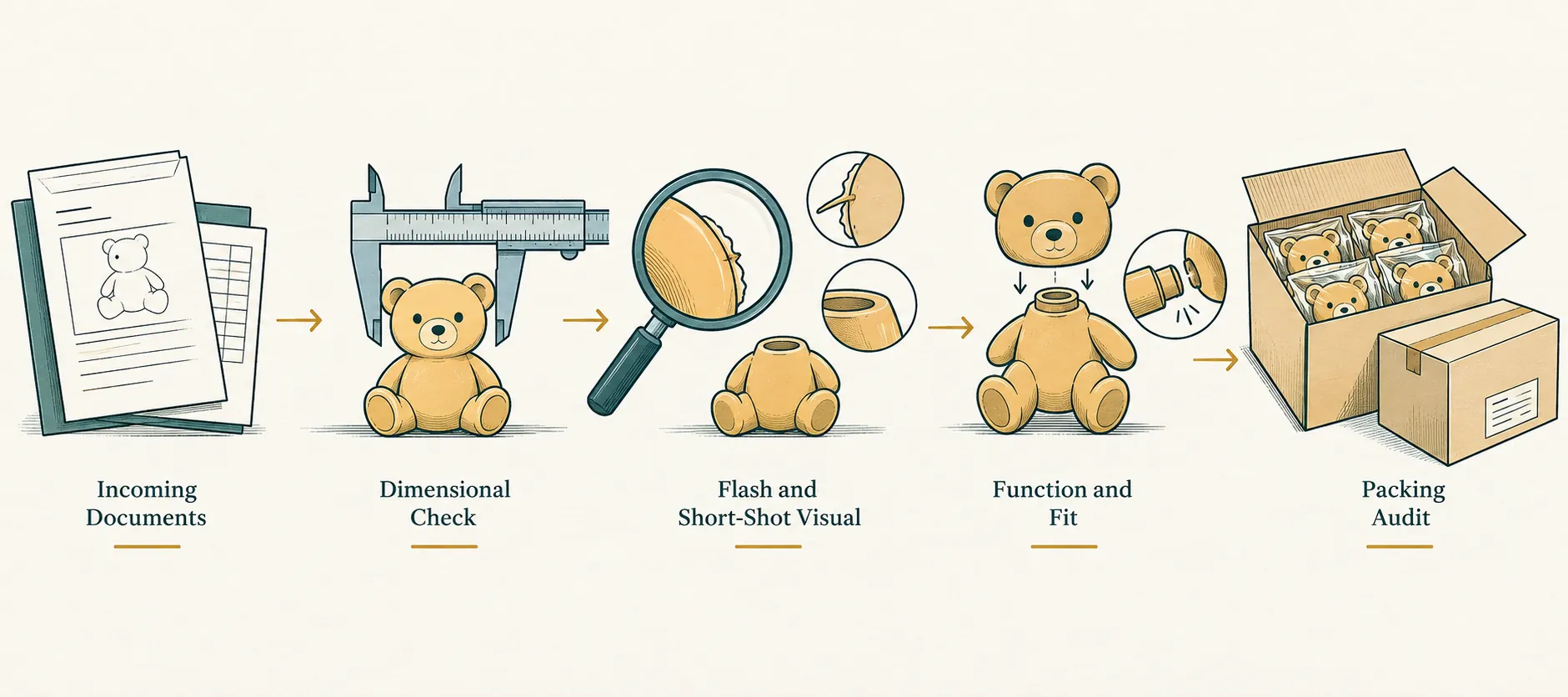
Inspect the closed shipping carton, not the sample. Four checks matter: dimensions and measurement units, piece count, weights, and shipping marks. Each has a record to compare against and a decision attached to the discrepancy.
Dimensions and units. Compare the measured packed carton against the pre-order packing data. A difference of a centimetre or two on a soft-sided carton is normal handling variation; a difference that changes the CBM band enough to move your freight quote is a commercial issue, not a rounding error. Agree a tolerance with the supplier in advance — for example, ±1 cm on each dimension — and treat anything inside it as accepted rather than as a failed shipment.
Count. Open and count at least one carton from the batch. The record to compare against is the packing list and the stated carton quantity. A short count is a direct cash loss at $0.27–$0.28 per piece, so a 264-piece carton that yields 258 pieces is a $1.62–$1.68 gap on that box alone. If the count is short, stop and reconcile the whole batch before releasing the balance.
Weights. Weigh one carton and compare net and gross against the packing list. A carton that is materially lighter than declared usually signals a short count or missing inner packaging; a heavier one may indicate added filler or moisture. Either way, the next decision is the same: hold payment and ask for a corrected packing list.
Shipping marks. Check that the carton carries the correct SKU, quantity, and destination marks, and that any carton label is legible and correctly placed. One US retailer's published vendor requirements specify cartons with a burst strength of 200 psi or greater and carton labels between 4 × 6 inches and 8.5 × 11 inches Carton Requirements. Those figures are that retailer's own vendor standard, not a universal rule — your destination's requirements may differ, so confirm them with your buyer or forwarder rather than assuming they transfer.
Strength. Carton burst strength matters most for soft, compressible goods that get stacked. Ask the supplier for the board grade and, where the buyer specifies one, the burst strength figure. A crushed carton on arrival damages the goods inside and can trigger a buyer chargeback, so this is worth one email before production.
What belongs in the goods subtotal — and what does not?
The goods subtotal is unit price × pieces. For the 264-piece carton at $0.27–$0.28, that is $71.28–$73.92. Nothing else belongs in it.
Freight is separate. Ocean or air freight, consolidation, and any destination charges are quoted by your forwarder against actual CBM and weight, which is exactly why the packed dimensions matter. Taxes and duties are separate again, assessed at import against the declared value and classification. Mixing any of these into the unit price makes the per-piece figure meaningless and hides where your money is actually going.
Packaging is already in the recorded price for the 264-piece cube, which ships in OPP. Custom packaging, mixed cartons, or private-label work are requests to be quoted, not entitlements included in the $0.27–$0.28 figure. If you need them, ask for a separate quotation and expect the unit price to move.
One more boundary: product-safety testing is a separate release check, not part of carton review. A carton that measures, counts and weighs correctly tells you nothing about whether the toy inside meets the applicable safety standard for your market. Treat those as two independent gates.
When does a carton minimum become a cash commitment?
A minimum order quantity is the smallest number of units a supplier will sell in one order, and suppliers set it to cover fixed production costs Descartes Finale. A one-carton minimum of 264 pieces is unusually low, which is what makes this SKU a realistic first order for an independent shop.
A carton quantity is not automatically an order multiple. The 264-piece figure tells you how many pieces are in a box; the minimum tells you how many boxes you must buy. Here the two coincide at one carton, so there is no surplus to absorb. Where a supplier requires five cartons of 192 pieces, the commitment is 960 pieces — and if you only need 500, you are paying for 460 you did not plan to sell.
That surplus has a cost beyond the goods. Higher minimums require larger inventory purchases and can raise warehousing costs and lengthen lead times inecta. Before you scale up, ask what the extra cartons do to your storage, your cash cycle, and your sell-through window.
If a minimum blocks a sensible test order, two practical routes exist. Consolidating several SKUs into one purchase order can reach a supplier's volume threshold while spreading your risk across products OneCart. Failing that, ask directly — suppliers are often open to discussion, particularly with established customers inecta. Neither is guaranteed, and neither changes the arithmetic: whatever you agree, the goods subtotal is still pieces × price.
Payment structure belongs in the same budget line. A common arrangement is a deposit with the balance before shipment, and a third-party pre-shipment inspection before that balance is a standard safeguard — published guidance cites roughly US$300–500 per inspection OneCart. On a $72 goods order that inspection cost exceeds the goods value, so decide deliberately whether the order size justifies it or whether a documented carton check by the supplier, with photos and a signed packing list, is proportionate.
Your one-page carton budget worksheet
Fill this in before you place the order, and again when the packed data arrives. The second pass is where most surprises surface.
Line 1 — Pieces per carton (recorded: 264). Line 2 — Cartons ordered (recorded minimum: 1). Line 3 — Total pieces (Line 1 × Line 2 = 264). Line 4 — Confirmed unit price EXW (indicative: $0.27–$0.28). Line 5 — Goods subtotal (Line 3 × Line 4 = $71.28–$73.92). Line 6 — Packed carton dimensions in cm, from the supplier. Line 7 — CBM per carton (L × W × H ÷ 1,000,000). Line 8 — Total CBM (Line 7 × Line 2). Line 9 — Gross weight per carton. Line 10 — Freight quote, from your forwarder, against Lines 8 and 9. Line 11 — Duties and taxes, assessed at import. Line 12 — Inspection or QC cost, if you commission one. Line 13 — Landed cost (Line 5 + Line 10 + Line 11 + Line 12). Line 14 — Landed cost per piece (Line 13 ÷ Line 3).
The unknowns you must close before committing: packed carton dimensions and gross weight, confirmed unit price at your order quantity, current freight rate, applicable duty and tax treatment for your destination, and whether any safety documentation is required for your market. None of these can be read off the catalog snapshot.
The next questions to send your supplier, in one message: what are the packed carton dimensions and gross weight for the 264-piece configuration; is the $0.27–$0.28 price current at one carton; what is the board grade and burst strength; and can you provide a signed packing list with piece count per carton. If you want to start smaller or compare entry points, the low-minimum range is a reasonable place to look, and a written quote will confirm current pricing and availability.
Carton budgeting questions buyers ask
Is $71.28–$73.92 the total I will pay?
No. That is the indicative EXW goods subtotal for one 264-piece carton at $0.27–$0.28 per piece. Freight, duties, taxes and any inspection cost are additional and must be quoted separately. The final landed cost depends on packed dimensions, weight, destination and current rates.
Can I order fewer than 264 pieces?
The recorded minimum for this configuration is one carton of 264 pieces, so a smaller quantity is not offered at that price. If you need a lower entry point, compare other low-minimum configurations or ask whether a smaller pack is available — treat any change as a request to be quoted, not an existing option.
How do I convert carton dimensions into freight volume?
Multiply length × width × height in centimetres, divide by 1,000,000 to get CBM per carton, then multiply by the number of cartons. Confirm the supplier's measurement unit first, and use the packed dimensions rather than the product dimensions.
What if the carton count is short on arrival?
Compare the physical count against the packing list and the stated carton quantity. A short count is a direct cash loss at the per-piece price, so hold the balance payment, photograph the opened carton, and ask the supplier to reconcile the batch before you accept delivery.
Does a correct carton mean the toy is safe to sell?
No. Carton inspection covers dimensions, count, weight, strength and marks. Product-safety compliance is a separate release check against the standard that applies in your market, and it requires the specified laboratory testing — not a visual or hand check.
Can I mix SKUs in one carton?
Mixed cartons are a request, not a standard option. Ask the supplier to quote a mixed configuration and confirm the resulting carton count, dimensions and price, since mixing changes both the packing data and the per-piece cost.
Sources
- MOQ Meaning: Minimum Order Quantity, Formula & Alibaba Guide | OneCart
- Carton Requirements
- Minimum Order Quantity (MOQ): What It Means, Calculation & Impact | Descartes Finale
- Understanding MOQ Meaning: A Comprehensive Guide to Minimum Order Quantities in E-commerce | inecta