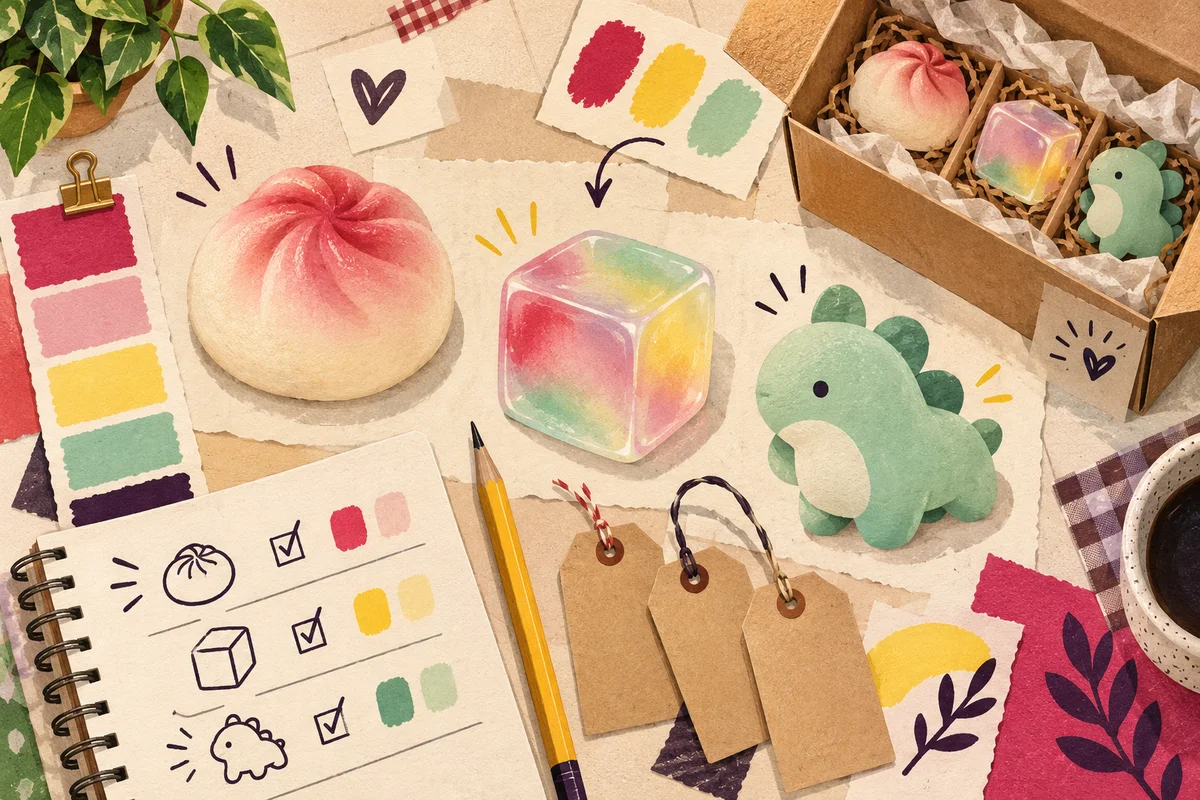
Choose a baozi squishy’s texture family before its color: sample a PU foam slow-rise bun for compression and recovery, or a TPR bead-filled version to assess the casing-and-filling combination. For baozi squishy toys wholesale, a practical first shortlist is one foam bun and one bead-filled bun of comparable stated size. Compare them by hand before requesting an order quote; product names, glitter and color do not establish rebound speed, softness or durability.
Which texture differences deserve attention now?
The useful distinction in the October 15, 2026 catalog is between foam construction, bead-filled formats and visual effects—not simply between colors. The assortment includes PU foam slow-rise buns, TPR color-bead and crystal-bead versions, and documented glow-and-glitter variations. Treat these as separate sample questions rather than interchangeable bun-shaped toys.
A German-language retail review updated August 18, 2026 describes mochi-style textures as soft, slightly tacky and elastic, compared with firmer, more uniform standard PU foam. That is qualitative seller commentary to guide a side-by-side comparison, not a measured specification for the products below. A TPR material label alone does not establish a mochi-like feel or identify every internal component. Baozi texture review
For a toy or gift shop, start with a foam-versus-bead comparison. A party supplier should also compare the smaller 5.5 cm format with the packaging footprint it needs. An online reseller should record how each sample actually compresses and recovers before writing texture descriptions. Measure purchasing preference through your own shelf or listing trial.
Which baozi squishy should you request as a sample?
| White Bun Slow-Rise Squishy, 8.5 cm Display Format — STS350800 | PU foam; 8.5 × 8.5 × 5 cm; display box; selling unit: piece; 288 pieces/carton; MOQ: 864 pieces; indicative EXW: $0.55/piece. Foam reference: is the compression resistance and recovery feel right for your display? |
|---|---|
| Zebra Bun Slow-Rise Squishy, 8.5 cm Display Format — STS350802 | PU foam; 8.5 × 8.5 × 5 cm; display box; selling unit: piece; 288 pieces/carton; MOQ: 864 pieces; indicative EXW: $0.55/piece. Compare the surface finish and rebound with the white bun rather than assuming the pattern changes the texture. |
| Gradient Bun Slow-Rise Squishy, 8.5 cm Display Format — STS350803 | PU foam; 8.5 × 8.5 × 5 cm; display box; selling unit: piece; 288 pieces/carton; MOQ: 864 pieces; indicative EXW: $0.55/piece. Sample question: does the finish retain the hand feel you selected in the foam reference? |
| Rainbow Bun Slow-Rise Squishy, 8.5 cm Display Format — STS350806 | PU foam; 8.5 × 8.5 × 5 cm; display box; selling unit: piece; 288 pieces/carton; MOQ: 864 pieces; indicative EXW: $0.55/piece. Choose the rainbow appearance only after checking surface feel and recovery. |
| Zebra Bun Slow-Rise Squishy, 10 cm Steamer Format — STS350801 | PU foam; 10 × 10 × 6 cm; display box; selling unit: piece; 288 pieces/carton; MOQ: 864 pieces; indicative EXW: $0.67/piece. Check grip and compression at the larger stated size, plus what steamer presentation is included. |
| Gradient Bun Slow-Rise Squishy, 10 cm Steamer Format — STS350804 | PU foam; 10 × 10 × 6 cm; display box; selling unit: piece; 288 pieces/carton; MOQ: 864 pieces; indicative EXW: $0.67/piece. Does the larger format suit the intended handling and display better than the 8.5 cm version? |
| Rainbow Bun Slow-Rise Squishy, 10 cm Steamer Format — STS350805 | PU foam; 10 × 10 × 6 cm; display box; selling unit: piece; 288 pieces/carton; MOQ: 864 pieces; indicative EXW: $0.67/piece. Compare the larger grip with the smaller rainbow bun before selecting by appearance. |
| Color-Bead Baozi Squishy, 8.5 cm TPR Format — STS350809 | Catalog material: TPR; stated size: 8.5 cm; display box; selling unit: piece; 144 pieces/carton; MOQ: 720 pieces; indicative EXW: $0.64/piece. A contrasting sample for tactile toy displays: assess bead movement, casing feel and recovery together. |
| Five-Color Baozi Squishy with Steamer Presentation — STS350815 | Catalog material: TPR; display box; selling unit: piece; 144 pieces/carton; MOQ: 720 pieces; indicative EXW: $0.41/piece. Request dimensions and exact presentation contents; compare compression rather than inferring texture from the five-color name. |
| Glitter Water-Bead Baozi Squishy, Steamer Display — STS350814 | Catalog material: TPR; display box; selling unit: piece; 288 pieces/carton; MOQ: 1,440 pieces; indicative EXW: $0.35/piece. Confirm filling composition and dimensions, then inspect casing, seams and containment on the sample. |
| Glow & Glitter Baozi Squishy, 5.5 cm — STS350810 | Catalog material: TPR; stated size: 5.5 cm; display box; selling unit: piece; 288 pieces/carton; MOQ: 1,440 pieces; indicative EXW: $0.35/piece. Check grip, compression and the glow effect under recorded viewing conditions. |
| Glow & Glitter Baozi Squishy, 8.5 cm — STS350811 | Catalog material: TPR; stated size: 8.5 cm; display box; selling unit: piece; 144 pieces/carton; MOQ: 720 pieces; indicative EXW: $0.60/piece. Compare handling with the 5.5 cm version; do not assume the same feel at a different size. |
| Transparent Crystal-Bead Dumpling Squishy — STS350816 | Catalog material: TPR; display box; selling unit: piece; 144 pieces/carton; MOQ: 720 pieces; indicative EXW: $0.55/piece. Request dimensions and filling details; assess how the visible beads move and how the casing feels. |
| Mystery Baozi Squishy Calendar, 24-Day Gift Format — STS350807 | Mixed sensory-toy materials; color box; selling unit: calendar; 48 calendars/carton; MOQ: 240 calendars; indicative EXW: $3.98/calendar, not per individual toy. Request the contents list and representative contents for review; this is a gift-format choice, not one consistent texture. |
| Sample decision record | Record product identifier, sample ID, construction and packaging revision, review date, intended texture and observed feel. Mark approve, hold or reject with conditions; name the responsible approver and date. Assign follow-up actions and record closure before releasing the order. |
What can a physical sample establish?
A sample can establish your observed preference for that sample’s resistance, surface feel and recovery; it cannot establish a guaranteed rebound time or the consistency of future production.
Press comparable samples in the same way and record relative impressions: softer or firmer, smoother or tackier, more uniform or more noticeably filled. Observe recovery without assigning invented seconds. For glow versions, record the light exposure and viewing conditions so the comparison is repeatable.
Inspect seams, surface damage, detachable parts and any escaped filling or glitter. Record odor on opening and at a later review rather than promising it will disappear. Hold the affected specification if a sample splits or releases filling; one such failure warrants investigation before ordering.
The Color-Bead Baozi Squishy suits a shop seeking a filled-texture contrast to foam. Do not choose it as a substitute for a uniform foam squeeze unless the sample comparison supports that choice. Likewise, choose the calendar for a multi-day gift presentation—not to deliver one predictable hand feel.
Sample handling is a commercial screen, not chemical or mechanical safety testing. Request the intended SKU-specific age labeling, warnings, construction details and relevant market documentation separately. A sample does not prove certification, stock, delivery timing or retail demand. Keep the approved sample and revision record for comparison; the record supports traceability but does not itself reveal every construction change.
How should you run a bounded texture-first shelf trial?
Test one foam bun against one bead-filled bun in the same placement, with a defined quantity, observation period and reorder threshold. Establish acceptable construction and product documentation before offering either for sale.
Hypothetical independent-shop trial: offer 24 saleable units of each selection for 14 days on the same counter fixture, with equal visibility and clearly displayed prices. Keep demonstration samples outside saleable inventory. Record units offered, units sold, price, days available and any condition complaints for each selection.
If the foam selection sells 18 of 24 units, its sell-through is 18 ÷ 24 × 100 = 75%. If the bead-filled selection sells 9 of 24, its sell-through is 37.5%. Using a hypothetical buyer-set threshold of 50%, review a reorder for the foam selection and hold expansion of the bead-filled selection. These are example calculations, not sales forecasts or industry benchmarks.
Those 24-unit shelf allocations are not supplier MOQs or a promised trial-order option. Request a smaller trial quantity or mixed carton before committing to a catalog minimum. If no suitable trial arrangement is agreed, keep the decision at the sample stage rather than treating a full MOQ as a small experiment. Reorder only after checking the remaining inventory, current quote and any safety or quality issues.
What should you ask before turning the sample choice into a quote?
Request a quote tied to the exact product identifier and approved sample revision, with the selling unit, presentation contents and order conditions stated explicitly.
Ask: Is the current EXW price still quoted per piece—or per calendar? Do the stated MOQ and carton quantity still apply? What are the dimensions, outer material and internal filling? Does the presentation include a steamer or other accessories? For the calendar, what contents are included in each selling unit?
Also ask whether a smaller sample-backed trial, mixed carton or customization is possible, and request its separate terms. These are requests, not confirmed services or order conditions.
Review the baozi product specifications, then submit the one or two shortlisted selections through the quote request with your sample observations and unresolved questions.